
Six weeks of kegels and nothing has changed
You found a routine, you have done it most days, and you are six weeks in with nothing to show for it. The reasonable conclusion is that this does not work.
Before you draw it, here are five things that are usually the actual cause, in the order they are usually the cause. The fifth one is a reason to stop training and get assessed.
Start here: six weeks is early
The trial cited most often for this, Dorey et al., 2004, in the British Journal of General Practice, ran its final assessment at six months. Its participants did not all train for six months: the control arm was offered the same programme only after the outcome assessment at three months, so roughly half the sample trained for six months and roughly half for three. What Dorey concluded from that is the number worth holding onto: the authors put the minimum at three months, and only for exercises that were properly taught in the first place.
Six weeks is short of that floor by half. The absence of a result at this stage carries much less information than it feels like it does. Keep going regardless and you may simply be doing the wrong thing well, so the useful question now is whether the training itself is right. The rest of this page is how to check.
Cause 1: you are training the wrong muscle
This is the most common one by a distance, and it is invisible from the inside. A body that cannot locate the muscle reaches for whatever is nearby instead, and whatever is nearby produces the same sensation of effort. Six weeks of it can pass with nothing to tell you which one you have been training.
Dorey's men were not working from a written cue. Each of their contractions had been verified on an instrument by a clinician before any of them trained alone, and almost nothing written for a general audience mentions that step.
If you have not checked, check before you change anything else. The mirror and the perineum hand check take a minute between them, and getting this wrong makes every other item on this list irrelevant.
Cause 2: the programme never got harder
A muscle adapts to a load and then stops adapting to it. Doing the same three sets of ten in week six that you did in week one is maintenance.
Progression here has several axes and most routines move none of them: how long each contraction is held, how long the release lasts, how many positions you train in, and whether you are doing the work under conditions that resemble when you need it. Dorey's participants trained in lying, sitting and standing rather than one comfortable position.
If your routine is identical to the one you started with, that is the finding.
Cause 3: you have only trained one half of it
Most instruction covers the contraction and stops. The release, letting the muscle fully lengthen and relax rather than simply ending the squeeze, gets either a sentence or nothing.
For ejaculatory control in particular this matters more than the squeeze does. A pelvic floor that sits at a raised resting baseline can produce a strong contraction on demand and still be part of the problem, and adding more contraction work to it is the wrong direction. There is a male clinical literature on this, and it is the subject of a separate piece.
The practical version: if you have never deliberately practised letting go, you have trained one direction of a muscle that works in two.
Cause 4: too little time under tension to matter
Ten quick squeezes take about a minute and feel like a session. They are not much stimulus.
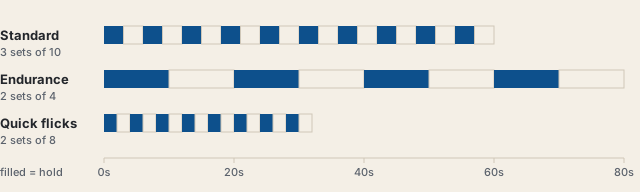
Time under tension is the number worth looking at, and it is the one nobody counts. Ten three-second contractions is thirty seconds of work. Four ten-second holds is forty seconds from a set that looks smaller on paper. If your routine has never included holds long enough to be uncomfortable near the end, the slow-twitch fibres that maintain engagement have not been asked for much.
Cause 5: this is not a training problem
The fifth cause is the one a page selling a training programme has every incentive to leave out, so here it is.
Some presentations do not respond to more repetitions because the cause is not weakness. Erectile difficulty that arrived suddenly rather than gradually, difficulty that is absent in some situations and present in others, new urinary symptoms, or pain during or after the exercises: each of those is a reason to get assessed. A fourth set will not address any of them.
Pain is the clearest signal on that list. If the training hurts, or leaves an ache afterwards, stop. Pelvic pain has its own clinical literature and its own treatment, and it is close to the opposite of what a strengthening routine prescribes.
Erectile function is also partly a vascular measure, and a change in it can be early information about something else. Take that to a doctor.
What a review of the whole literature says
Myers and Smith, 2019, in Physiotherapy, is a systematic review of pelvic floor muscle training for erectile dysfunction and premature ejaculation in men over 18. Ten trials met their criteria.
Three of their findings are worth having in front of you at week six. The included studies were of low to moderate methodological quality with discrepancies in reporting. The heterogeneity between them was not conducive to pooling the data. And no optimal training protocol has been identified.
That last one is the load-bearing sentence. The training protocols in those trials varied significantly in therapist contact, concurrent interventions, length, frequency and intensity. Nobody has established which version is best, which means anybody presenting one specific routine as the validated one is telling you something the literature does not support.
We are not quoting an improvement rate from that review, because the figure that circulates in summaries of it could not be confirmed against the paper itself.
What to do this week
In order.
- Confirm the contraction, with the mirror and the hand check. If it is ambiguous, get it checked by someone who can examine you.
- Look at whether anything in your routine has changed since week one. If not, change one axis: hold length first.
- Add release work if you have never done it deliberately.
- Count your actual time under tension for one session. The number is usually smaller than expected.
- If any of the cause-five signals apply, stop and book an appointment. That is the correct outcome of this article for some readers.
The free 7-day plan is a structured version of steps one to three, and it starts with the contraction check rather than assuming it.